
Friday, June 13, 2008

Wednesday, June 11, 2008
Day 7 - Lost in the Andes
So, after enjoying the many and varied sights of central Cuzco, we decided to take a pleasent day-hike into the surrounding countryside to see a few more Incan ruins. Though no reliable maps exist for the area in which we´d be hiking, we had a guidebook with instructions like "Continue along this track for about 50 meters, enough to steer clear of the houses, children and dogs, and then leave this secondary road altogether, striking off to the right and begin hiking east, skirting around fields and depressions."


The rocks that might be something.


Partially buried underground (whether by Incans trying to hide it from the Spaniards or the Spaniards trying to cover it up, is unclear), Cusilluchayoc is a site with a variety of stone carvings, walls, rooms, etc. It was clearly something...as opposed to the earlier rocks, which I maintain were probably nothing.


Peering over the mountain


What could possibly go wrong?
We began by stopping by the central plaza in Cuzco to pick up supplies like water and food for the hike. For safety, I also purchased a compass since, being an Eagle Scout, even if we got lost, I´d be able to find my way back to North America. Knowing he was probably the only outfitter in town who sold compasses at 8 AM, the shop owner was nice enough to charge us a bleeding fortune for a compass that he probably got out of a Cracker Jack box, but such is the nature of supply and demand. We then struck out North-West of the city and visited our first stop of the day.
Sacsayhuaman
Pronounced amusingly similar to "sexy woman," Sacsayhuaman was most likely a sanctuary and temple to the Sun. Only about 20% remains, thanks to the Spanish conquerors dismantling most of its stones for use elsewhere, but it´s still pretty impressive.


From Sacsayhuaman, we headed East along nicely paved roads to Qenqo Grande.
Qenqo Grande
Originally used as a temple, Qenqo Grande (not not to be confused with the more cutely titled amphitheater Qenqo Chico, which is across the street), was also a temple.


Chris on the King´s Throne, which sounds about right, and a row of stone niches for idols.
It was from Qenqo Grande that our trip became a little more interesting. To reach our next stop, we had to cut across some fields and a stream. Uncertain of whether we had actually reached our next destination (another temple complex called Cusilluchayoc), we took some pictures of a bunch of rocks that appeared to be something (as opposed to nothing) and then moved on to our next stop, the easily located and clearly signed Laqo.

The rocks that might be something.
Laqo
Originally functioning as the Temple of the Moon, Laqo served as a temple and observatory. Sadly, little remains (at least as far as we could tell) but more interesting were the archeological digs going on at the foot of the hillside. There, workers were slowly revealing the complementary Temple of the Sun, and have thus far only uncovered some foundational walls and fragments of pottery.


A woman selling trinkets nearby was also kind enough to point us in the proper direction for Cusilluchayoc, the place we´d been looking for earlier. It´s worth noting, however, that we could have just posted the random rock photo from before and none of you would have known the difference. Sadly, neither did we.
Cusilluchayoc
Partially buried underground (whether by Incans trying to hide it from the Spaniards or the Spaniards trying to cover it up, is unclear), Cusilluchayoc is a site with a variety of stone carvings, walls, rooms, etc. It was clearly something...as opposed to the earlier rocks, which I maintain were probably nothing.


Considering our difficulty finding Cusilluchayoc from the directions in our guidebook, one would think that further directions leading up and into the mountains, away from any sort of civilization, would give us reason for pause. If one thought that, one would be wrong. Without a care in the world, we crossed a stream, avoided some dogs and began climbing into the mountains. According to the guidebook, it was just two kilometers to the next site. Two kilometers along a well worn trail to the town of Chilcapuquio.
We would never see it.
The trail was not only difficult to traverse, climbing hundreds of meters into the mountains (made all the more difficult by the thinness of the air), but was also difficult to follow, with forks branching off repeatedly, none of which were mentioned by our guidebook. Thankfully, the scenery in the Andes was nothing if not impressive.


After hiking for far longer than 2 kilometers, becoming completely exhausted and finding ourselves at the base of yet another mountain, we began to get concerned. The trail had become increasingly difficult to follow, as it seemed to fade in and out the further we went. Our courage, however, was renewed when we found some horse manure and recently left garbage, meaning we were still on at least some sort of trail that had recently been used.
This, we realized, was what "rock bottom" felt like. Garbage and horse manure were what cheered us up.
We continued on and half way up the mountain the trail essentially vanished. After much deliberation (and against Chris´ better judgment) I sprinted up to the top to see what I might see on the other side. If there was nothing, we would turn back.

Peering over the mountain
Miraculously, there was a town and a paved road in the distance. We weren´t going to die in the Andes afterall, hallelujah. After spending the next 10 minutes attempting to catch my breath, I yelled down to Chris the exciting news, we met back up and made our way to the town. As it turns out this town was mentioned in our guidebook, so we asked locals for directions to the next major stop, which thankfully was a brief 30 minute walk down a well paved road.
Tambo Machay
Perhaps one of the most impressive bits of ruin we´d seen thus far, Tambo Machay is an amazingly well preserved sacred space and resting or hunting grounds used by the Incans. A natural spring still runs from the mountainside and the stone channels and fountains are still in working order 700 years (give or take) since they were built.


There was one more site on our list of places to visit on our simple, charming day hike. Puka Pukara, a sort of Incan Hotel, was within site of Tambo Machay. At that point, however, we were so tired we didn´t care and this was a close as we got. Enjoy.

And that was our brief stroll in the Andes. When we finally got back to our hostel around dinner time, the word "collapse" really isn´t sufficient to describe what we did. However, after some soup, a variety of pain medications and a good night´s sleep, we left Cuzco the next morning for Urubamba to visit the Incan agricultural laboratory Maray and the salt flats at Salineras, both of which are far more impressive than a bunch of rocks that are probably nothing. Full descriptions and pics are forthcoming, so stay tuned.
-Sean
Monday, June 9, 2008
Quick Cuzco update!
 We are finishing up our third day in Cuzco! It is a beautiful town which has a definite European feel, although as Sean says, "the demographics are a bit off." :) It feels like a slightly run-down small town in Spain, with tons of colonial architecture and, of course, INCAN architecture as well! One picture I posted here is of a random wall in Cuzco. In the middle is a patch of original Incan masonry. It´s very obvious and incredible. Remains of their structures are all over the place here. You can´t walk a few feet without seeing some Incan stonework.
We plan to do a big update in a day or two, but this is just a quick note to say how our past three days have gone. We arrived after the Purgatory Bus Ride, so took it easy that day, resting a ton and getting used to the thin air here. You feel winded just sitting down at first. It´s weird. So...... on our
 second (technically our first full) day here we did the following: had a big breakfast at some swanky café, went to a religious art museum, then to Qorikancha (important Inca palace), did a tour of the cathedral, had lunch in another café on the main plaza, went to an Andean dance performance (walked all over trying to find the theater - the first one we tried to find didn´t exist), and then went out for a few drinks afterwards. And all of this was on foot! Needless to say, we both fell prey to altitude sickness during the night!!! Sean´s hit first, and then mine. Headaches, stomachaches, nausea, etc. We didn´t do anything today until 1pm. NICE. Reading our tourbooks today, we saw that all the books recommend taking at least two days to adjust, resting, not walking a lot, eating light meals, drinking plenty of water, abstaining from alcohol, etc. So we did a real bang-up job on that.
 Anyway, we feel better now and had a mellow day going to a Pre-Colombian art museum, eating some traditional Cuzqueñan food for dinner, and planning our next few days in the Sacred Valley (the valley outside of Cuzco).
Tomorrow we will be hiking to the Inca site Sachsayhuaman and surrounding ruins, some of the hike taking us through farmland and small towns. The day after we´re leaving Cuzco to trek further into the Sacred Valley to Urubamba, a town that will serve as our jumping-off point to Moray and Salinas, two towns in the middle of nowhere with some amazing Incan constructions. The next day is Ollantaytambo with... Incan ruins, and a quaint old town. Then comes the big one - MACHU PICCHU!!!! After that comes the transfer to Argentina.
More updates in the coming days. Hope everyone is doing OK!
-- Chris
Saturday, June 7, 2008
Abandonar toda esperanza, usted que entra aqui.
In the 14th century, Dante Alighieri wrote the epic poem The Divine Comedy, which illustrated the Christian conception of an afterlife as it existed at the time and which is now considered one of the great pieces of literature in the history of Europe. In it, Dante described how when Satan was cast down to Earth from Heaven, the impact of his body hitting the Earth was so great, that it created a giant crater reaching all the way to the center of the Earth. The crater was filled over, thus forming Hell, but the impact also caused the earth surrounding the crater to lift up, creating a mountain. Thus, "Mt. Purgatory" was formed as a place for those who had not sinned greatly enough to be sent straight to Hell. It was there that they would have to wait for eternity, attempting to scale the mountain to cleanse themselves of their sins and ascend to Heaven.
In other conceptions of Purgatory, it is a place of tormenting fire which cleanses the soul, a place merely of limbo-like eternal waiting, or an intermediate stage between life and death.
According to Dante, Mt. Purgatory was somewhere in the Southern Hemisphere of the Earth. Though the Roman Catholic Church no longer officially supports this conception of Purgatory as an actual physical place, I feel I must disagree. I have experienced it and it does involve mountains.
Purgatory, as it turns out, is a 14 hours bus ride from Nazca to Cuzco.
I know...I was surprised too.
We boarded the bus and things started off quite whimsically, with a game of Bingo on the bus. Interspersed with the numbers being called at random were trivia questions and various challenges that the passengers could compete in. To get a question correct gave the winner the right to choose which number was called next. Chris was the first to jump up when the challenge was to make three animal noises into the microphone and after successfully impersonating a pig, duck and a cow, he was allowed to pick three numbers. Now, since we were both playing, one would think that he would have compared our Bingo cards and selected numbers that we both needed, thus increasing the chances of one of us winning. Instead, he just picked numbers that he needed. Then, when he realized what he had done, he was so flustered that he stopped translating the new numbers being called over the speaker for me, which effectively screwed me out of any chance of winning Bingo since I had no idea what numbers were then being called.
After Bingo, it was announced that a movie would be beginning shortly. We were also asked not to use the bathrooms for anything other than urination. Considering the large dinner Chris and I had had shortly before boarding and the already delicate status of our digestive systems, this announcement was cause for concern, since we were only 1 hour in with 13 hours to go and no stops.
Then, the movie began. I generally expect movies in such circumstances to be like those on airplanes; highly edited action films or bland romantic comedies. The bus company Cruz del Sur, however, felt that the 1980 World War 2 epic The Red One, starring Lee Marvin, Mark Hammill and Robert Carradine was the optimal choice as everyone futilely attempted to fall asleep. Thus, for the next 3 hours, we couldn't help but watch such classic moments from American Cinema such as when Lee Marvin spanked a Nazi youth or when one of Mark Hammill´s testicles was blown off, in all its gory detail.
It was also around this time that we started to enter the mountains. There were no streetlights, which is probably for the the best since if we´d actually been able to see the "road" twisting through the mountains, we would have been scared out of our minds. However, we could certainly feel every single curve and switchback as we wound our way through the Andes towards Cuzco and both Chris and I slowly began to get nauseous. We tried to sleep, but Lee Marvin wouldn´t allow it. The film eventually did end, but even then the constant lurching of the bus and the moderately uncomfortable bus seats made sleep little more than a desperate wish.
The next morning, still with hours to go, another film was played. I firmly believe that the bus company people were screwing with us at that point because their selection for the morning movie was Lilo and Stitch...2. This was accompanied by a breakfast of olive paste on a roll and a cookie. After Lilo and Stitch 2 ended, one might wonder what the natural follow up to a straight to DVD children´s cartoon and a WW2 film from the 80´s would be. If you were to guess VH1´s Divas Live, a benefit concert starring Celine Dion, Mariah Carey, Aretha Franklin, Gloria Estefan and Shania Twain, you would be correct. You would also be out of your %$"&! mind.
There´s nothing quite like arriving in Cuzco, Peru, the capital of the Incan Empire, to the strains of "Man! I Feel Like a Woman!" Were it not for the fact that we knew it would eventually end, we would have thought we were actually in Hell. However, because there was a definite and eventual end to the ordeal, we realized it was all just some contemporary manifestation of the cleansing fires or simply a modern means of travel up Mt. Purgatory.
And that´s how we got to Cuzco. To get back to Lima, we´ve decided to fly.
In other conceptions of Purgatory, it is a place of tormenting fire which cleanses the soul, a place merely of limbo-like eternal waiting, or an intermediate stage between life and death.
According to Dante, Mt. Purgatory was somewhere in the Southern Hemisphere of the Earth. Though the Roman Catholic Church no longer officially supports this conception of Purgatory as an actual physical place, I feel I must disagree. I have experienced it and it does involve mountains.
Purgatory, as it turns out, is a 14 hours bus ride from Nazca to Cuzco.
I know...I was surprised too.
We boarded the bus and things started off quite whimsically, with a game of Bingo on the bus. Interspersed with the numbers being called at random were trivia questions and various challenges that the passengers could compete in. To get a question correct gave the winner the right to choose which number was called next. Chris was the first to jump up when the challenge was to make three animal noises into the microphone and after successfully impersonating a pig, duck and a cow, he was allowed to pick three numbers. Now, since we were both playing, one would think that he would have compared our Bingo cards and selected numbers that we both needed, thus increasing the chances of one of us winning. Instead, he just picked numbers that he needed. Then, when he realized what he had done, he was so flustered that he stopped translating the new numbers being called over the speaker for me, which effectively screwed me out of any chance of winning Bingo since I had no idea what numbers were then being called.
After Bingo, it was announced that a movie would be beginning shortly. We were also asked not to use the bathrooms for anything other than urination. Considering the large dinner Chris and I had had shortly before boarding and the already delicate status of our digestive systems, this announcement was cause for concern, since we were only 1 hour in with 13 hours to go and no stops.
Then, the movie began. I generally expect movies in such circumstances to be like those on airplanes; highly edited action films or bland romantic comedies. The bus company Cruz del Sur, however, felt that the 1980 World War 2 epic The Red One, starring Lee Marvin, Mark Hammill and Robert Carradine was the optimal choice as everyone futilely attempted to fall asleep. Thus, for the next 3 hours, we couldn't help but watch such classic moments from American Cinema such as when Lee Marvin spanked a Nazi youth or when one of Mark Hammill´s testicles was blown off, in all its gory detail.
It was also around this time that we started to enter the mountains. There were no streetlights, which is probably for the the best since if we´d actually been able to see the "road" twisting through the mountains, we would have been scared out of our minds. However, we could certainly feel every single curve and switchback as we wound our way through the Andes towards Cuzco and both Chris and I slowly began to get nauseous. We tried to sleep, but Lee Marvin wouldn´t allow it. The film eventually did end, but even then the constant lurching of the bus and the moderately uncomfortable bus seats made sleep little more than a desperate wish.
The next morning, still with hours to go, another film was played. I firmly believe that the bus company people were screwing with us at that point because their selection for the morning movie was Lilo and Stitch...2. This was accompanied by a breakfast of olive paste on a roll and a cookie. After Lilo and Stitch 2 ended, one might wonder what the natural follow up to a straight to DVD children´s cartoon and a WW2 film from the 80´s would be. If you were to guess VH1´s Divas Live, a benefit concert starring Celine Dion, Mariah Carey, Aretha Franklin, Gloria Estefan and Shania Twain, you would be correct. You would also be out of your %$"&! mind.
There´s nothing quite like arriving in Cuzco, Peru, the capital of the Incan Empire, to the strains of "Man! I Feel Like a Woman!" Were it not for the fact that we knew it would eventually end, we would have thought we were actually in Hell. However, because there was a definite and eventual end to the ordeal, we realized it was all just some contemporary manifestation of the cleansing fires or simply a modern means of travel up Mt. Purgatory.
And that´s how we got to Cuzco. To get back to Lima, we´ve decided to fly.
BLOG CONTEST #1
The first person to guess correctly on the comments page gets a knick-knack tchotchke gift from Peru!!!
Here is your riddle:
Yesterday between the Nazca Lines fly-over and visiting the aqueducts, we went to a site known as Chauchilla. While there, we found these things just on the ground. We left them there but not before clicking a few pics.
WHAT ARE THEY?


Here is your riddle:
Yesterday between the Nazca Lines fly-over and visiting the aqueducts, we went to a site known as Chauchilla. While there, we found these things just on the ground. We left them there but not before clicking a few pics.
WHAT ARE THEY?


THE NAZCA LINES
THE NAZCA LINES
 The big thing to do is shell out fifty bucks to go up in a four- or six-seater Cessna for a half hour flight over the lines. That is what Sean and I did yesterday!!! The flight was surprisingly not scary, but the constant banking from side to side for people on both sides of the plane to see the lines, along with the air pressure changes as we went up and down, made me start to feel queasy. As the flight continued my quest for the lines became two-fold: to experience the lines and to hold down the sweet beckon of a vom session right there in the plane. Luckily we made it back down OK, without me having vomited all over the place. Sean and I did like that the barf bags supplied by the airline company had a map of the lines on one side of them, and an ad for a hotel/restaurant on the other. We were going to snag one on our way out, but, ironically, thinking directly about vomit would have made me have to use the bag we had just snatched. So no barf bag souvenir. :(
CLICK TO ENLARGE PICTURES OF THE LINES -- THEY ARE MUCH MUCH EASIER TO SEE WHEN YOU CLICK TO ENLARGE THEM. :)
Preparing to thumb our noses
at God.


Here we go!


Take off!!

Flying over farmland and then desert to get to the lines.


THE LINES:

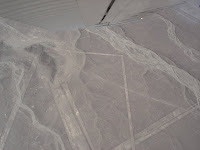

Lines ending in large trapezoidal shape.


Perhaps the most famous of all the geoglyphs. The astronaut. He is on the hillside - a very simple humanoid figure with big eyes and his hand waving.


Two pictures of the condor.


The Monkey!

Spirals and shapes and shit.

Three pictures of the hummingbird.


Viewing platform. All geoglyphs are on the right side. At the top are hands, then a tree, and then the lizard. The PanAmerican highway cuts right through the tail of the lizard. Neat.

Spiral.

NOTE:
Sean and I are at an Internet café in Cuzco right now, composing the THREE glorious entries for you all to read. :) He will be on duty for the, er, colorful bus trip we took to get here, while I am writing about yesterday´s adventures and our first BLOG CONTEST!
Yesterday we left Lima at 4:30am for the six hour bus trip to Nazca to see the famous Nazca lines. It was, in my  opinion, one of the single coolest things I have ever seen ... EVER. I have read about the Lines for years and have always wanted the honor of seeing them in person -- it was quite the adventure!!
 opinion, one of the single coolest things I have ever seen ... EVER. I have read about the Lines for years and have always wanted the honor of seeing them in person -- it was quite the adventure!!
The basic premise is that between 200BC and 700AD the Nazca people created a series of lines and symbols (called geoglyphs) in the arid Nazca Desert plains. There are some shapes but most of the geoglyphs are of animals. They created them simply by brushing away a few inches of the top layer of sand to reveal a lighter color sand beneath. No one knows why they constructed them, especially since they can only be viewed from the air. It´s a total mystery, and some people think it proves the existence of aliens and UFO´s. They are gigantic and some are really elaborate. There is no wind and hardly any rain in this desert and the lines have survived for 2000 or so years in excellent condition!
 The big thing to do is shell out fifty bucks to go up in a four- or six-seater Cessna for a half hour flight over the lines. That is what Sean and I did yesterday!!! The flight was surprisingly not scary, but the constant banking from side to side for people on both sides of the plane to see the lines, along with the air pressure changes as we went up and down, made me start to feel queasy. As the flight continued my quest for the lines became two-fold: to experience the lines and to hold down the sweet beckon of a vom session right there in the plane. Luckily we made it back down OK, without me having vomited all over the place. Sean and I did like that the barf bags supplied by the airline company had a map of the lines on one side of them, and an ad for a hotel/restaurant on the other. We were going to snag one on our way out, but, ironically, thinking directly about vomit would have made me have to use the bag we had just snatched. So no barf bag souvenir. :(
Below are our pictures of the lines. It was the most incredible experience to look down at these lines and see them in person. I have wanted to see these things for YEARS, and I always talk about them in the classroom. Words cannot describe how it felt to see them, and contemplate the people who spent so much time making something they would never be able to see and appreicate like we can today.
Enjoy the pics! I only picked the best, but some are still difficult to make out, just because of the angle of the shot, the light, etc., but do your best!!!
CLICK TO ENLARGE PICTURES OF THE LINES -- THEY ARE MUCH MUCH EASIER TO SEE WHEN YOU CLICK TO ENLARGE THEM. :)
On the dusty, barren road to Nazca.

Waiting for our flight at the airport (basically nothing
more than an airstrip outside of town.)
more than an airstrip outside of town.)


Preparing to thumb our noses
at God.


Here we go!


Flying over farmland and then desert to get to the lines.


THE LINES:
The whale.


Lines ending in large trapezoidal shape.


Perhaps the most famous of all the geoglyphs. The astronaut. He is on the hillside - a very simple humanoid figure with big eyes and his hand waving.


Two pictures of the condor.


The Monkey!


Spirals and shapes and shit.

Three pictures of the hummingbird.


Viewing platform. All geoglyphs are on the right side. At the top are hands, then a tree, and then the lizard. The PanAmerican highway cuts right through the tail of the lizard. Neat.


Spiral.

AQUEDUCTS of NAZCA
 6/14/08 - After the lines, we went to the site of today´s WELCH's BLOG CONTEST, and then afterwards went to see the aqueducts. The Nazca people did not have a reliable source of fresh water, so they constructed underground aqueducts that brought water from the Andes - which are many, many miles away. Our taxi driver acted as tour guide and explained that the tunnels had to be routinely cleaned, so the Nazca build access points along the way. Groups of workers descend these holes in the tunnels with tools to scrape and clean the rocks and come up at the next access hole down the way. The Nazca built spirals that led down to these access holes. They are the cones of Nazca. The amazing thing is that they are STILL USED TODAY to supply water to the people of this
  town. They are still cleaned annually in much the same way as before. In these pictures you can see our guide showing me the access point, held in place by a 1000 year old tree trunk, along with the point where the aqueduct comes out from its tunnel and flows freely in a canal that leads to the city. This area is now a park, and is of course protected because it is the city´s water source. Butting up to the property was a beautiful farm with workers in traditional Peruvian garb. It was a truly amazing experience to visit this place! Enjoy the pics. - Mr. Welch
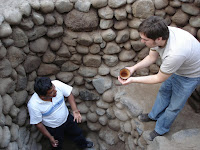
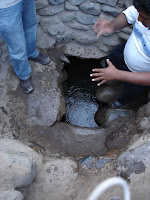

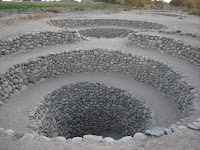
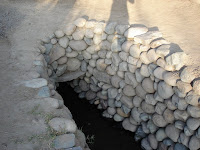
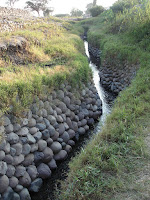

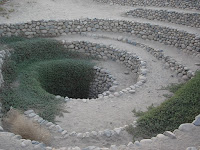

 6/14/08 - After the lines, we went to the site of today´s WELCH's BLOG CONTEST, and then afterwards went to see the aqueducts. The Nazca people did not have a reliable source of fresh water, so they constructed underground aqueducts that brought water from the Andes - which are many, many miles away. Our taxi driver acted as tour guide and explained that the tunnels had to be routinely cleaned, so the Nazca build access points along the way. Groups of workers descend these holes in the tunnels with tools to scrape and clean the rocks and come up at the next access hole down the way. The Nazca built spirals that led down to these access holes. They are the cones of Nazca. The amazing thing is that they are STILL USED TODAY to supply water to the people of this
  town. They are still cleaned annually in much the same way as before. In these pictures you can see our guide showing me the access point, held in place by a 1000 year old tree trunk, along with the point where the aqueduct comes out from its tunnel and flows freely in a canal that leads to the city. This area is now a park, and is of course protected because it is the city´s water source. Butting up to the property was a beautiful farm with workers in traditional Peruvian garb. It was a truly amazing experience to visit this place! Enjoy the pics. - Mr. Welch


Subscribe to:
Posts (Atom)